The Biro Hours: Britain’s Taped-Up Shop Notes and the Art of Being Briefly Away
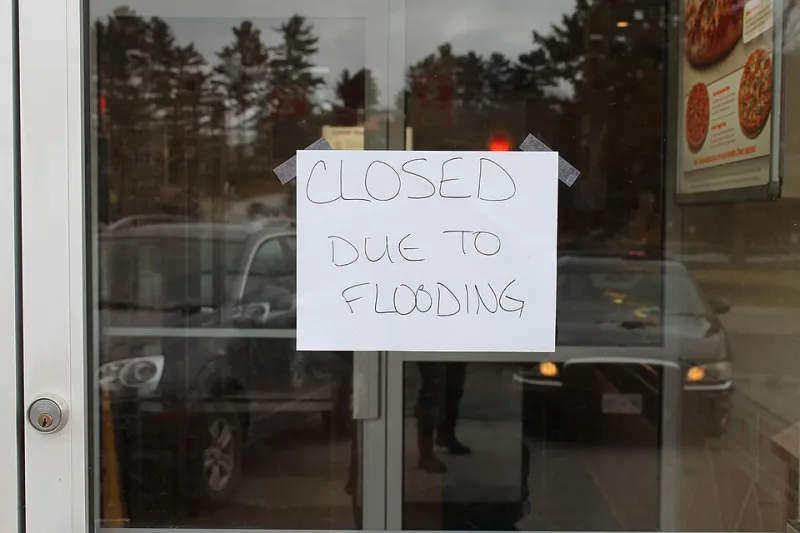
Photo: Town of Bancroft, CC BY 2.0, via Wikimedia Commons
There is a particular kind of British design that never gets a case study. It is written in biro on the back of a delivery note, stuck to a glass door with tape that has gone slightly furry at the edges. It says something like: Gone to lunch. Back 2ish. Sorry. It is not beautiful in the way a poster is beautiful. It is better than that. It is useful, human, and almost always slightly wonky.
The temporary closed sign is a fragment of everyday life that arrives precisely when the high street is meant to be open. It is an interruption in the retail day, but also a small piece of public communication — a note passed from shopkeeper to stranger. In an age when even the corner caff has an Instagram grid, these scraps of card and marker feel like the last unfiltered feed.
The notice as a tiny building
A shopfront is a controlled face: the fascia, the window display, the opening-hours vinyl. The handwritten note is the bit that escapes. It is architecture at the scale of a Post-it. A rectangle of card becomes a door, a wall, a temporary room in which the shopkeeper explains themselves. Back in 5. Gone to the cash and carry. Closed due to family circumstances. The language is blunt because the situation is blunt.
What makes these notes design rather than mere admin is the way they solve a problem with whatever is to hand. A florist uses a length of ribbon. A butcher uses a greaseproof-paper square. A charity shop uses the back of a donated birthday card, which feels accidentally perfect. The materials are not neutral. They carry the memory of the place: the wholesaler’s logo, the old price sticker, the faint impression of a shopping list on the reverse.
A grammar of absence
The wording has its own rules. There is the apology, usually bracketed or tacked on at the end. There is the estimate of time, often optimistic. There is the reason, which can be specific or beautifully vague. Back soon. Back in a bit. Gone for bait. Closed for the day. The note is a promise and a disclaimer at once. It says: I have not vanished, only stepped away.
Some signs are almost literary. One notice spotted in a Yorkshire bakery reportedly read: Oven trouble. Back when the oven is less troubled. Another, taped to a Bristol record shop, offered: Listening to a man about a dog. Normal service shortly. These are not just excuses. They are tiny performances of personality, the shopkeeper’s voice leaking out through the letterbox.
Materials, weather, and the honest blot
The weather is a co-author. A biro note left in a sunny window fades to a ghost. A marker sign on a rainy door bleeds at the corners until the words look underwater. Sellotape yellows. Blu Tack leaves a grease spot. The notice becomes a record of the days it has survived, which is more than most printed vinyl can claim.
There is also the matter of handwriting. The best notes have the urgency of a shopping list: sloping letters, a word crossed out, an arrow pointing to the doorbell. A laminated A4 sheet is a different genre — more official, less alive. The handwritten scrap feels like a message in a bottle, even if the bottle is a newsagent on a Tuesday afternoon.
Regional dialects of delay
The phrasing shifts as you move around the UK. In the North East, a shop may be gone for bait. In Cornwall, someone might be back dreckly, which is a time signature all of its own. In parts of Scotland, a note might say back in a wee while. In London, the language is often stripped to the studs: Back 10 mins. No apology. No name. Just the fact of the gap.
These variations are not folklore for their own sake. They are evidence of how local speech survives in commercial spaces. The handwritten notice is one of the few places where a shopkeeper can sound like themselves rather than like a brand. It is a tiny act of linguistic independence, taped to the inside of the glass.
The slow disappearance of the handwritten hour
As of 2026, the temporary sign is under pressure. Shops reach for Facebook or WhatsApp to announce a late opening. They print a quick A4 at the library. They buy a ready-made Closed sign with a clock dial and a moveable hand. All of these are more legible, more professional, and less likely to be mistaken for rubbish. But they are also less likely to be kept.
A handwritten note has an afterlife. It gets folded into a drawer, used as a bookmark, photographed by a passer-by. It becomes part of the visual clutter that makes a street feel lived in. The printed sign is efficient, but it does not absorb the day in the same way. It does not go soft at the edges.
What the tape holds together
The temporary closed sign is a small reminder that shops are run by people who need lunch, who get stuck in traffic, who have a dentist appointment at 3.15. It is a fragment of honesty in a retail landscape that otherwise wants to appear seamless. It also reminds us that design is not only what is planned. It is what gets improvised when the door is locked and the queue has gone.
So next time you see a scrap of card fluttering against a shop window, read it properly. It is a tiny piece of folk typography, a local dialect, a material history, and a promise. Back in five. Or thereabouts.