Cracked, Chipped, Cherished: The Quiet Rescue of Britain’s Estate Mosaics
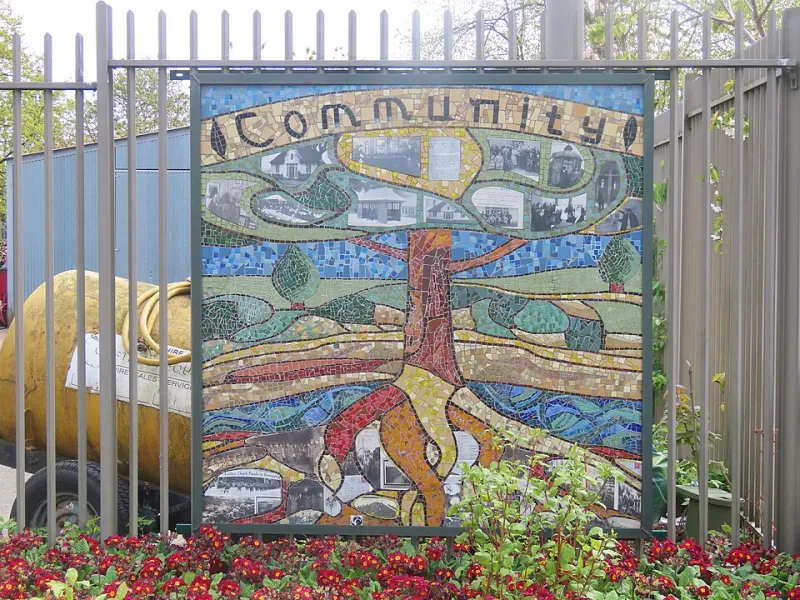
Photo: Elliott Brown, CC BY-SA 2.0, via Wikimedia Commons
Start with a fragment. In a car park in a Midlands town, a strip of blue and gold tesserae survives beneath peeling paint. It is not famous. That is the point. Britain is full of public mosaics made in the decades after 1945 — on housing estates, in shopping precincts, beside schools, above chip shops, in underpasses and stairwells — and many have spent years hiding in plain sight. In 2026, small volunteer groups are trying to bring them back into view, not by polishing them into theme-park nostalgia, but by treating the broken pieces as evidence of a place and its people.
The post-war mosaic was rarely a grand gesture. It was civic decoration with a budget. Councils, developers and architects commissioned murals and mosaic panels for new estates and precincts; community workshops let residents and schoolchildren design motifs. Some were abstract, some were fish, birds, industry, maps, saints, space rockets. They were part of the route to the shops. Then the shops changed, the cladding went up, the car park was resurfaced, and the artwork became a background detail — or a problem.
Fragmenta is drawn to this kind of thing because a mosaic is already a fragmentary form. Thousands of small pieces, some missing, all held together by grout and guesswork. The city is a collage of overlapping histories. These panels are the bits that fell out of the official story.
The tile as witness
A mosaic is an unlikely archive. It records what a place could afford, what it wanted to say, and who was allowed to help say it. The colours may reflect local materials or a manufacturer's catalogue. The motifs may show a civic version of the area — a ship, a factory, a dove — or a child's drawing translated into ceramic. The damage is part of the record too. A cracked tile can show where a bin was bolted, where a pram scraped, where a generation leaned. Repair that erases every mark can erase the social history as well.
That is why the best rescue projects do not aim for a false original. They aim for a legible one. Old photographs help volunteers work out what was there. Oral histories help them work out why it mattered. Salvaged tiles from skips, architectural salvage yards and donor appeals fill the gaps. Sometimes the new pieces do not match exactly. Good. A visible seam is an honest label: this part was rebuilt in 2026 by people who cared enough to try.
The car park problem
The hardest mosaics to save are the ones in car parks, stairwells and shopping parades. They are not always listed. They are difficult to photograph. They sit behind wheelie bins, under layers of paint, above a loading bay. Volunteers working in cities such as Sheffield, Bristol and Coventry have learned to read council minutes, local newspaper archives and family albums for clues. A blurry wedding photo can show a panel that no longer exists. A former resident can remember the colour of a dolphin. A retired tiler can identify the adhesive.
This is slow work, and it is social work. A conservation project becomes a memory project. People who would not come to a heritage meeting will come to a session about the precinct they grew up in. The mosaic gives them permission to talk about the ordinary places that shaped them: the bus stop, the bakery, the walk to school. The artwork is the hook, but the catch is local history.
Repair as a creative act
There is a temptation to compare this to kintsugi, the Japanese practice of mending pottery with gold. It is a useful comparison, but British council-estate repair is usually less precious and more pragmatic. Volunteers use what they can get. They learn to cut tiles. They argue about grout. They run workshops where children make new pieces for a border. The result is not a museum object restored to day one. It is a living surface with a new chapter.
That creative act matters because it changes who gets to be an author of a place. A mosaic designed in 1962 by an architect and made by a workshop is one kind of artwork. A mosaic repaired in 2026 by a group of residents, with help from a tiler and a local historian, is another. The second version carries the first inside it, like a palimpsest. It says that care is part of the design.
Why it matters now
Public art is under pressure. Local authority budgets are tight, development is fast, and the easiest thing to do with an awkward old panel is to cover it. Listing is not always the answer; not every mosaic is a masterpiece, and preservation can freeze a place in the wrong way. But documentation, maintenance and creative reuse can keep these works in the conversation. In 2026, digital archives, walking tours and small zines are helping people find mosaics they did not know were there. A QR code beside a stairwell is not a substitute for a roof, but it is a start.
The deeper argument is about value. Britain has a habit of saving the exceptional and letting the everyday go. But the everyday is where most people live. A mosaic above a precinct is not just decoration; it is a public statement that a new estate deserved colour. It is a fragment of civic ambition, made by hands, stuck to a wall, left to weather. When volunteers piece it back together, they are not only restoring tiles. They are restoring a bit of belief that ordinary places are worth looking at.
Next time you park in a multi-storey, look at the stairwell. Next time you queue at a precinct, look above the shutters. The lost artwork is not always lost. Sometimes it is waiting for a torch, an old photograph and a box of salvaged tiles.