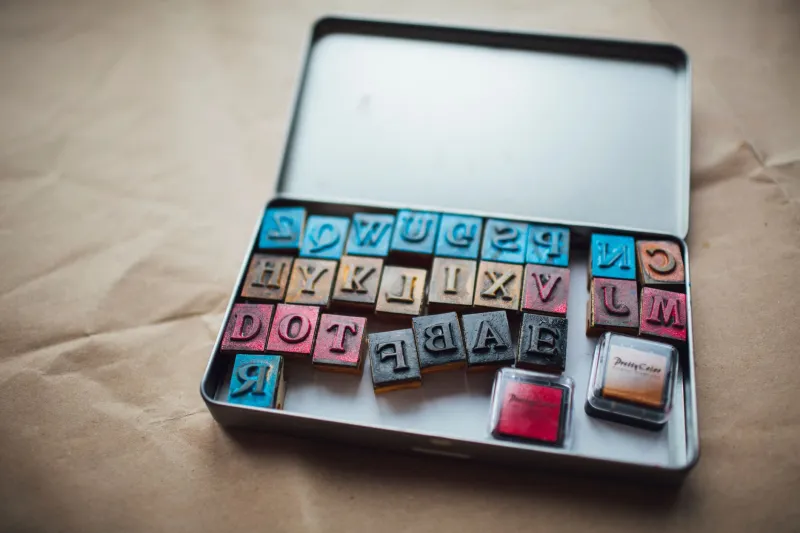
Daub and Dab: The Unlikely Typographic Folk Art of Britain’s Bingo Boards
Photo: hand-painted bingo board UK working men's club numbers, via as1.ftcdn.net
On a Thursday night in a church hall in Salford, the caller lifts a wooden ball from a bag and the room goes quiet. Behind him, propped on an easel, is a board of hand-painted numbers. It is not a precious object. It has a coffee ring near 63 and a strip of masking tape over 47. But it is doing something design rarely gets to do: it is being read at speed, at distance, by a room full of people who will notice immediately if it lies.
The board as a small architecture
A bingo board is a grid before it is a picture. Ninety numbers, usually in columns of ten, with the caller’s master board above or beside it. The layout is a small piece of information architecture: numbers large enough to see from the back row, columns aligned so the caller’s eye can travel without losing place. In older halls, the board might be hardboard painted white, with numerals in signwriter’s enamel. Later versions use stencils, rub-down Letraset, or a careful hand with a marker. The best boards share a quality: the numbers are slightly too big for their boxes, as if the painter knew that legibility matters more than neatness.
Colour is functional and then accidental. Red for the called numbers, black for the rest, green baize behind. Over years, the red fades to a dusty pink; the black goes grey at the edges. A board in a seaside arcade might be sun-bleached on one side. A board in a northern club might be varnished to a shine. The palette is not chosen by a brand consultant. It is chosen by what was in the cupboard.
A regional alphabet of wear
There is no single British bingo board, only a family of them. A church basement board often looks improvised: hymn-board numbers reused, a sheet of plywood, a hook for the caller’s clipboard. A working men’s club board is heavier, framed, perhaps with a sliding shutter or a rail of hooks. A seaside hall board has the bleached optimism of a place that expects a summer crowd. In each case, the board records its own history. Dabber ink blooms at the corners. Chalk ghosts sit in the grooves. A repair might be a neat strip of white tape with 47 written in biro, or a circle of sticky-backed plastic that has gone amber.
These are not flaws in the design. They are the design continuing after the painter has gone home. The board is never finished because the hall is never finished. Numbers get lost, corners get knocked, somebody spills tea. The object absorbs the room.
The ritual of the call
The call itself has a rhythm. ‘Eyes down’ is the switch. Then the numbers arrive with their nicknames: two little ducks, legs eleven, Kelly’s eye. The board is the silent partner. The caller checks the master; the players glance at the board; the dabbers move. In that loop, typography becomes choreography. A numeral that is easy to misread is a small failure of design. A numeral that is easy to find is a small kindness.
Hand-painted boards have an advantage over screens: the wobble. A printed 8 and a printed 3 can look similar at distance; a hand-painted 8 has a different weight, a different lean. Regular players learn the board’s handwriting. They know that this hall’s 7 has a long tail, that this club’s 9 is almost closed. The board becomes a local typeface, and the caller becomes its reader.
What the boards know
Many halls have swapped to digital displays, and there is nothing wrong with a clean screen. But the old boards survive in cupboards, church basements and working men’s clubs because they work. They are legible, repairable and cheap. They also carry something a screen cannot: the evidence of hands. A board is a small archive of every person who painted it, corrected it, propped it up and read it aloud.
This is folk art in the plainest sense: made within a tradition, for use, without asking to be looked at. It sits outside the gallery and inside the evening. It reveals a British design instinct that is pragmatic, local and quietly expressive. The board does not announce itself as culture. It just holds the numbers steady while the room leans in.
Eyes down. The board does the rest.