A Single Glove, Carefully Bagged: Notes from Britain’s Lost Property Rooms
The first thing you notice is the umbrellas. Not one good umbrella, but a thicket of them: telescopic, golf-sized, a child’s frog-print version with one broken rib. They lean in a tall bin near the door of a lost property room in a British city, waiting for owners who mostly will not come. Around them are shelves of clear bags, each containing a small surrender: a single glove, a phone charger, a paperback with a sun-bleached cover. It is not a museum. But it has the same basic grammar — objects, labels, shelves, a system of care — and it asks the same question in a blunter way. What do we keep, and why?
The taxonomy of almost
Lost property offices sort the world by circumstance rather than meaning. A train station might file items by date and location: ‘found on the 08:14 to Leeds’, ‘left in the waiting room’. A bus depot might use broad categories: bags, clothing, electronics, ‘miscellaneous’. Festivals develop their own taxonomy — tent, wellie, glittery hat, inflatable flamingo — because a festival’s lost property is a portrait of collective optimism followed by collective hangover. The labels are practical, not poetic. They record where an object was found, not what it was doing there.
The single glove is the unofficial mascot. It arrives without its partner, which makes it both useless and oddly poignant. Umbrellas are the same: Britain’s weather supplies them, and Britain’s forgetfulness leaves them behind. In one room, staff might keep a box of reading glasses, a drawer of keys, a shelf of children’s toys. False teeth turn up, often in a glass of water that has been carefully carried in. Dentures are perhaps the purest lost property: deeply personal, slightly comic, and almost never claimed.
The categories reveal habits. Commuters lose headphones, scarves, travel mugs and phones. Night-time travellers lose coats and dignity. Festival-goers lose tents, sleeping bags and the will to carry anything home. Parents lose buggy covers, dummies, soft toys. Each pile is a small census of British daily life, organised not by class or taste but by distraction.
Shelves of last resort
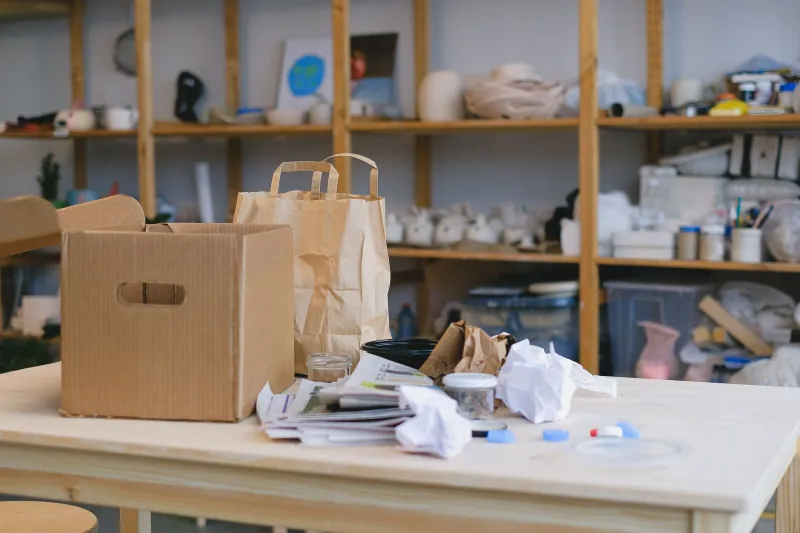
The furniture is gloriously unglamorous. Metal shelving units, grey plastic crates, clear polyethylene bags, brown paper envelopes, luggage tags, a lamination machine that has seen things. In better-funded offices there are proper pigeonholes and rolling racks; in improvised ones, a coat rail and a stack of boxes do the job. The design is accidental, but it is design nonetheless. The clear bag turns an object into an exhibit. The tag becomes a wall label. The shelf becomes a chronology.
This is the anti-museum: no vitrines, no interpretation panels, no audio guide. The only provenance is a date and a place. ‘Found: Waterloo, 14 October.’ ‘Found: back of a bus, Birmingham.’ The object’s biography is cut short at the moment of loss. Who owned it, why it mattered, whether it was a gift or a replacement — none of that survives. What remains is the thing itself, usually mass-produced and unremarkable, suddenly singled out by separation.
Staff become curators without the title. They decide what to keep, how long to keep it, when to dispose of it, and whether to donate it. In the UK, the legal framework differs by operator and council, but the practical rule is often a holding period followed by auction, charity or recycling. The umbrellas go to charity shops or staff; the phones are wiped and disposed of; the single gloves go to textile recycling. There is an ethics to it, quiet and unsentimental. The room is not a shrine. It is a way station.
The residue
What lingers is not always valuable. A child’s teddy bear in a supermarket bag. A birthday card still in its envelope. A handmade scarf with a dropped stitch. These are the objects that make lost property staff pause, because they carry obvious emotional weight. The expensive watch is easy: log it, lock it, hope. The handwritten notebook is harder. It has no resale value and no owner in sight, but it is irreplaceable in the way that only ordinary things can be.
The claimed objects are just as revealing. People will travel across London for a favourite umbrella, but leave a designer jacket. They will describe a phone with the urgency of a missing pet. They will arrive at a depot with a photograph of a glove. The return is a small ceremony: proof of ownership, a signature, a thank-you. The object goes back into the world, and the shelf closes over the gap.
The unclaimed objects are the true collection. They are what Britain forgets when it is busy, tired, late or slightly drunk. They are the material shadow of the commute, the festival, the night out, the school run. A lost property office is not a museum of important things. It is a museum of almost-missed things, and its displays are always changing.
A museum without provenance
Perhaps that is why these rooms feel oddly moving. They are full of objects that have been stripped of context but not of use. An umbrella can still keep someone dry. A glove can still warm a hand, if the hand turns up. The room holds that possibility in suspension. It is a holding pattern for the everyday.
The next time you lose something on a train, imagine the shelf. Imagine the bag, the label, the date. Imagine the small, hopeful bureaucracy that receives it. It is not glamorous, but it is a kind of care. Britain’s lost property rooms are accidental archives of who we are when we are not paying attention — and they are, in their own unassuming way, worth a visit.