The Suds Are Temporary, the Signage Is Forever: A Field Guide to Britain’s Launderette Windows
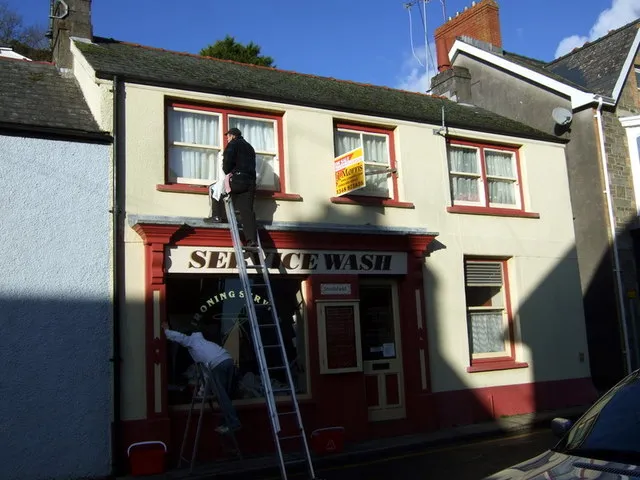
Photo: ceridwen, CC BY-SA 2.0, via Wikimedia Commons
On a wet Tuesday in a town that shall remain somewhere between the precinct and the ring road, the launderette window is doing more work than the washing machines. Behind the glass: a hand-painted 'OPEN' sign in a shade of yellow last mixed in about 1994, a laminated list of rules with one corner curling like a damp paperback, and a fluorescent price board that has been amended so many times it now reads like a palimpsest in marker pen. Nobody designed this. Which is exactly why it is worth looking at.
The British launderette window is an accidental gallery of everyday typography. It is also a noticeboard, a rulebook, a price list and a small public address system. And as the country loses more of these rooms to redevelopment, coffee chains and the simple economics of having a washing machine at home, the window is becoming a archive of a particular kind of urban life: communal, slightly shabby, and held together with tape.
A vernacular in three fonts
Most launderette windows speak in at least three visual languages. First comes the hand-painted opening hours: confident, wonky, often applied directly to the glass in white or gold. The lettering tends toward a kind of unlicensed art-school modernism — fat rounded numerals, a 'T' that leans like it has had a long day, a colon made from two hopeful dots. It is not meant to be admired. It is meant to be legible from across the road, ideally while you are carrying a bin bag full of towels.
Second comes the printed notice, usually laminated. These are the rules: 'PLEASE DO NOT LEAVE MACHINES UNATTENDED', 'LAST WASH 30 MINUTES BEFORE CLOSING', 'NO DUVETS OR RUGS'. The lamination is crucial. It says: this information has been tested by reality. It has survived steam, condensation and at least one person trying to wash a horse blanket.
Third comes the improvisation. A strip of masking tape with a new price written in biro. A A4 sheet announcing a change to Sunday hours, held up by four pieces of Blu Tack and the optimism of the proprietor. A small, carefully aligned card that says 'SERVICE WASH AVAILABLE — ASK INSIDE'. These are the fragments that make the window feel alive. They are also the bits most likely to disappear when a place changes hands and someone decides a clean pane of glass is better for business.
The rules are the art
Look closely at any launderette window and you will find a recurring cast of characters. There is the crossed-out price, usually amended upward, with the old number still visible underneath like a ghost. There is the handwritten arrow pointing to a door that is not the door you thought it was. There is the notice that begins 'Due to unforeseen circumstances' and ends without explaining what those circumstances were, leaving you to imagine a broken boiler, a family emergency or a dispute about a duvet.
Then there are the commandments. Launderette rules have a tone all of their own: firm, weary, faintly biblical. 'PLEASE RESPECT OTHER USERS.' 'DO NOT PUT COLOURED ITEMS IN WITH WHITES.' 'ANY CLOTHING LEFT FOR MORE THAN 48 HOURS WILL BE REMOVED.' The last one is always slightly alarming, as if the owners are running a small, soapy version of the storage wars.
What makes these notices visual art, rather than just admin, is the way they are arranged. A price list taped at eye level. A warning about the dryer placed lower, near the handle. A cheerful 'THANK YOU' sticker stuck at the bottom, almost as an afterthought. The window becomes a composition of urgency and courtesy. It tells you what to do, what not to do, how much it costs and — in the gaps — something about the person who runs the place.
What gets taped, crossed out and kept
Ask anyone who has spent time in a launderette and they will tell you the window is never static. Notices migrate. A new timetable is taped over an old one, then partially peeled back to reveal the previous version. Phone numbers are added in biro. A charity collection box appears and disappears. The window is a living document, updated in real time by people who are often mid-shift, mid-conversation and mid-spin cycle.
The things that get preserved are telling. Old opening hours painted on the glass are rarely removed, even when the actual hours change; they are simply contradicted by a laminated sheet. A faded 'SERVICE WASH' sign stays up long after the service has stopped, because taking it down would require a decision. The window accumulates history in layers, like a wall of torn gig posters, except the medium here is sticky tape and the subject is domestic labour.
And then there is the stuff that gets crossed out. Prices. Names. Days of the week. The word 'ONLY' in front of 'CASH'. Each crossing-out is a small correction, a negotiation between the ideal version of the business and the one that actually turns up on a Monday morning. The result is a design language of second thoughts — and it is far more interesting than a clean vinyl sign printed by a franchise.
The social room with a spin cycle
The window matters because the room behind it matters. Launderettes are among the last unpretentious indoor public spaces in many British towns: warm, bright, vaguely tropical, and open to anyone with a pound coin and a bag of washing. They are places where you might overhear a conversation about a neighbour's boiler, a local election, or the correct way to fold a fitted sheet. They are also, quietly, a form of social infrastructure.
That is why the current wave of closures feels like more than a change in laundry habits. When a launderette becomes a coffee shop or a block of flats, the window goes blank. The hand-painted hours disappear. The laminated rules disappear. The small, improvised notices that told you where to park, when to collect your washing and how much a service wash cost — all gone. What replaces them is usually a single, professionally printed sign with a logo and a website. It is legible, consistent, and completely without incident.
This is not nostalgia for dirty clothes and damp Mondays. It is an argument for noticing what gets lost when everyday design is tidied away. The launderette window is a record of how people actually communicate: in biro, in tape, in crossed-out numbers and hopeful arrows. It is a design vernacular that belongs to nobody in particular and everybody who has ever stood outside one, waiting for the spin cycle to end.
How to read a launderette window
- Start with the hand-painted hours. Are they still accurate? Is there a laminated sheet contradicting them? That gap is the story.
- Find the most amended notice. Count the crossings-out. A price changed three times is a small economic history.
- Look for the 'please' notices. The tone of a launderette is written in its requests, not its rules.
- Check the bottom corners. That is where the thank-yous, the charity boxes and the out-of-date phone numbers live.
- Notice what is missing. No prices? No hours? A blank window is rarely neutral; it usually means someone has given up or moved on.
Before the glass goes blank
The next time you pass a launderette, give the window a second look. It is not just a barrier between you and the dryers. It is a small, accidental exhibition of British everyday design: provisional, practical, and made by hand. The suds are temporary. The signage, for as long as it lasts, is not.