The Lamp That Came Back: Notes from a Saturday Repair Bench
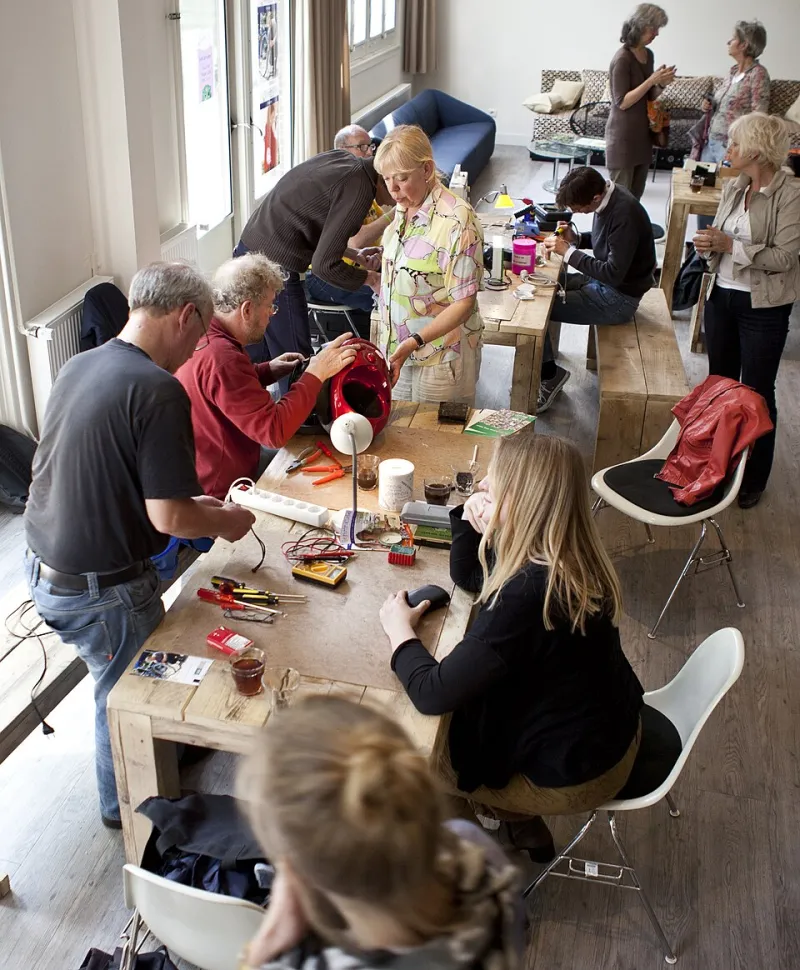
Photo: Ilvy Njiokiktjien, CC BY-SA 3.0, via Wikimedia Commons
On a wet Saturday morning in a church hall somewhere in the Midlands, the urn is doing its thing and a queue is forming by the door. People arrive carrying carrier bags, cardboard boxes and, in one case, a floor lamp held together with electrical tape and hope. This is a repair café: part clinic, part social club, part accidental museum.
The format is simple enough. Volunteers with soldering irons, multimeters and a dangerous amount of patience sit behind tables. Visitors bring broken things. Tea is drunk. Sometimes the thing is fixed. Sometimes it is not. Either way, something passes between people and objects that rarely happens in a shop: attention.
The museum of almost-broken things
Look closely at the tables and you see design history laid out like a jumble sale. A toaster with a case that seems to have been sealed by a security services contractor. A radio with a dial that still clicks beautifully but a power lead that has given up. A kettle whose failure is not dramatic, just quietly terminal. The objects are ordinary, which is exactly why they are interesting.
Design failure has a smell: hot dust, old plastic, the faint whiff of a capacitor that has had enough. It also has a shape. Sealed units. Glued casings. Screws with heads designed for a factory robot rather than a human being. The repair café is where those decisions come home to roost. You can talk about planned obsolescence in the abstract, but it is more persuasive when someone is trying to open a blender with a butter knife and a sigh.
The volunteers are not magicians. They are often retired engineers, hobbyists, tinkerers, people who like a puzzle with a plug on the end. They cannibalise parts from donor machines. They solder. They 3D-print a replacement knob. They consult wiring diagrams on tablets. And sometimes they say the thing that no shop assistant ever says: it might not be worth fixing, but let us have a look anyway.
What gets mended, and why
People do not bring everything. They bring things with a biography. A lamp from a grandmother’s house. A radio that belonged to a father. A toy that a child has outgrown but not forgotten. The economic logic is often shaky; a new kettle can cost less than an hour of anyone’s time. But repair is not only an economic act. It is a way of voting for a different kind of relationship with stuff.
The UK’s right-to-repair rules, introduced in 2021, gave the conversation a legal spine, but the real driver in these halls is affection. There is also stubbornness, which is underrated. Britain has a long, complicated relationship with make-do-and-mend. Sometimes it is framed as wartime virtue, sometimes as thrift, sometimes as a quietly radical refusal to throw things away. In a repair café, those strands sit around the same table.
What gets fixed is often less important than what gets noticed. A cracked casing can be a clue to how something was used. A repaired lead can show where a cable was pulled too tight for years. A toy with a new arm is no longer the same toy, but it is still loved. The object has been edited, not replaced.
The secret life of objects
After a repair, the thing goes home changed. It carries a tiny scar, a new screw, a slightly mismatched switch. That is not a flaw; it is a record. The object now has a second chapter, and the person who owns it has a story about the Saturday they took it to the church hall and someone had a go.
Repair cafés are temporary museums because nothing is accessioned. There are no labels, no glass cases, no opening hours beyond the session. The exhibition assembles itself and disperses by lunchtime. The lamp goes home. The table is wiped down. The urn is switched off. But the fragments remain: a fuse saved, a toy rearmed, a kettle given one more winter.
In 2026, when so much design is designed to be replaced, that is worth piecing together.