Tear-Off Tabs and Laminated Truths: Reading the Village Noticeboard as Accidental Folk Art
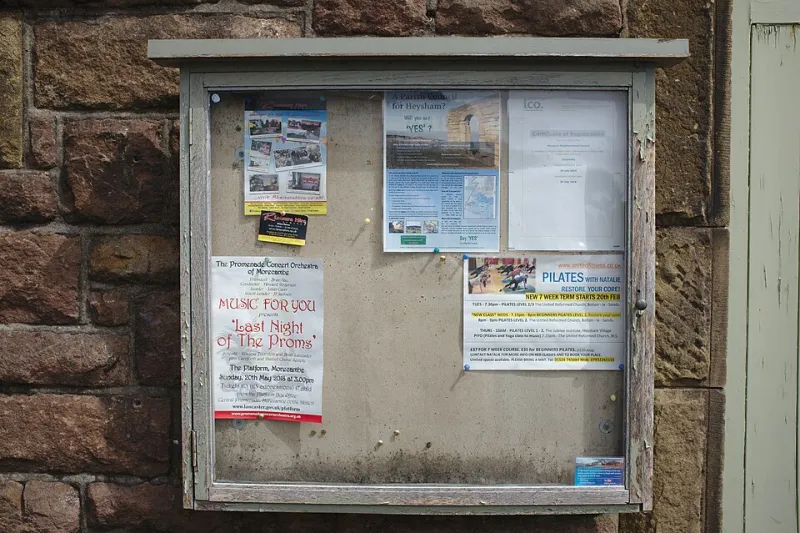
Photo: Bob Harvey , CC BY-SA 2.0, via Wikimedia Commons
The board is outside the village hall, under a shallow wooden hood that keeps off some of the rain but not all of it. There are eleven notices on it. Two are for events that already happened in August. One is a laminated warning about dog fouling, with a photograph. One is a handwritten note in green biro correcting the time on a printed poster, which has been corrected again in pencil below. And along the bottom edge, a fringe of tear-off tabs, half of them gone.
Nobody designed this. Everybody designed this.
A palimpsest in pine
There is a word for what happens to a noticeboard over a decade, and the word is palimpsest — a surface written on, scraped back, written on again. Except nothing here has been scraped back. Layer goes over layer, and the older layers show through at the corners: the yellow ghost of a sellotape square, a pin hole with a rust ring around it, the corner of a 2019 fete poster still stapled under three newer ones.
It is, functionally, a collage. And like a collage, its meaning lives partly in the accidents — the overlap, the mismatch of scale, the meeting of a typed agenda and a child's felt-tip drawing of a scarecrow.
The anatomy of a board
Look closely and a grammar emerges.
- The statutory layer. Parish council notices, planning applications, the official stuff. Usually typed, usually A4, usually pinned square.
- The commercial layer. The mobile dog groomer, the chimney sweep, the piano lessons. Often with tear-off tabs, always battling for the bottom edge.
- The civic layer. Village hall bookings, the WI, the allotment association, the church fete rota.
- The vernacular layer. Handwritten, photocopied, photographed, corrected. This is where the board becomes interesting.
- The residue. The corpses: curled, faded, months out of date. Nobody takes them down because taking things down is somebody's job, and that somebody is busy.
Tabs, fringes, optimism
A tear-off tab is an act of faith. You print forty of them, you pin the poster, and you assume that forty people will pass, want your thing badly enough to rip a strip of paper off, and then remember where they put it.
When the tabs are all gone it means something. When they're untouched after three weeks it means something else, and the board records it either way. There's a particular melancholy to a poster whose tabs are intact but whose event has passed — the fringe still fringed, the number still available, the moment gone.
The correction is the artefact
My favourite thing on any board is a correction. A venue changed. A time moved. A price went up by fifty pence. The person with the key — or more often the person who simply always carries a biro — has drawn an arrow, crossed something out, added a note in the margin.
Designers spend careers trying to achieve the warmth that a biro correction delivers for free. It says: a human being looked at this, thought about it, and cared enough to fix it badly rather than leave it wrong. In a culture saturated with quietly updated digital listings, there is something almost radical about an error that has been visibly, publicly, imperfectly mended.
Lamination as a vernacular
The laminated sign is the noticeboard's answer to permanence, and its aesthetic is now completely established: the slight sheen, the bubble in the corner, the white border trimmed by eye with scissors, the four drawing pins at the corners because one corner always lifts. Laminated warnings are the board's moral voice — dog fouling, speeding, litter, the unfilled water trough, the gate that must be kept shut. They are also the closest thing Britain has to street-level folk typography: Comic Sans, Arial bold, a clip-art paw print, a red exclamation mark placed by an amateur with total conviction.
Who gets to pin
Here is the quiet politics of it. On a public wall, the default is trust. There's no moderator, no algorithm, no queue. Someone decides you're allowed to pin a thing, and usually that someone is the caretaker, and usually the answer is yes.
That openness is why the board reads the way it does. It's the last genuinely mixed public surface most villages have: the church and the union branch and the puppy-training class and the missing cat, all at the same visual volume, all equally entitled to a rectangle.
What the feed cannot do
We have better tools than ever for telling each other things. And yet the board persists, and arguably thrives, because it does something a feed can't: it's a single place, physically shared, that everyone passes whether or not they're looking for it.
You don't subscribe to a noticeboard. You don't get served more of what you already liked. You get the bus timetable, a lost glove, a coffee morning and a warning about the ford — and you get them in the same field of view, on the same damp afternoon, stapled into the same soft pine.
Look at it properly
Next time you're waiting outside a village hall, give the board thirty seconds. Notice the overlaps. Notice the corrections. Notice which posters have lost their tabs and which haven't. It is a portrait of a place, updated continuously by everyone and signed by no one, and it is being quietly, carelessly, beautifully made in front of you.