Underfoot Modernism: A Field Guide to Britain’s Pub Carpet Patterns
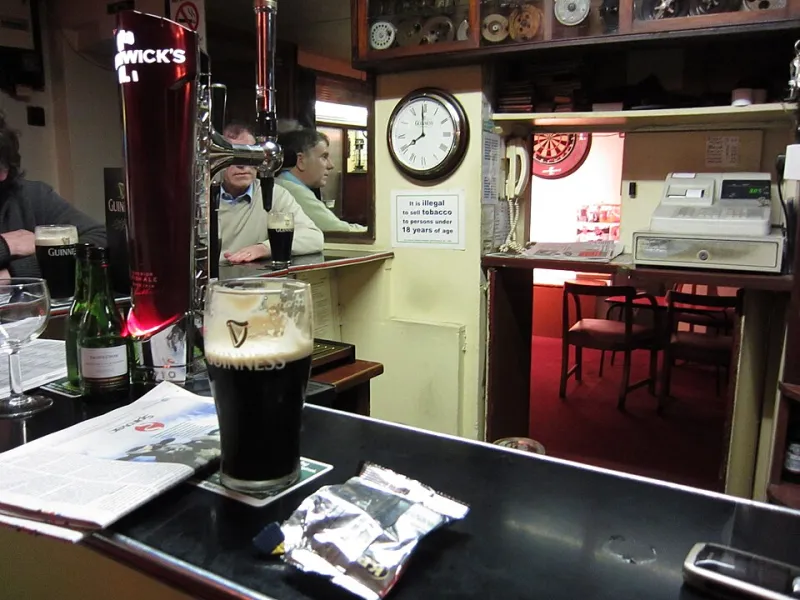
Photo: Pamela Norrington , CC BY-SA 2.0, via Wikimedia Commons
A pub carpet is easy to ignore. It is underfoot, after all, and usually carrying a pint’s worth of history. But look down in the right lounge bar and you will find one of Britain’s strangest branches of public design: a floor covering that is part practical necessity, part accidental modernism and part regional fingerprint.
The floor as a design archive
Carpets arrived in pubs for sensible reasons. They softened noise, hid spills and stopped people sliding across polished floors. In the 1960s and 1970s, synthetic fibres and bold dyes made it possible to cover large spaces in patterns that would previously have been unthinkable. Breweries and pub companies turned those patterns into brand identities. A certain shade of orange, a certain lattice, a certain swirl could tell you where you were before you had read the menu.
That is why pub carpets matter. They are not usually designed as art, but they are public, repeatable and everywhere. They are also vulnerable. A carpet can be ripped out in an afternoon. Unlike a listed ceiling or a stained-glass window, it rarely gets a second look from a conservation officer. The best ones survive by accident, not policy.
A rough taxonomy
The field guide is necessarily imprecise. Pub carpets mutate, fade and get patched. But certain types recur.
- The Swirl. Interlocking loops, often in orange, brown and cream. It looks like a lava lamp that has been flattened and given a job in hospitality. The swirl is the great survivor of the 1970s lounge bar.
- The Diamond Lattice. A repeating grid of diamonds, sometimes with a faintly Tudor air, sometimes with a faintly airport hotel air. It is the pattern equivalent of a firm handshake.
- The Floral Thunderstorm. Dense blooms in colours that should not meet, let alone marry. Best viewed from a slight distance, ideally with a bag of crisps.
- The Lounge Bar Abstract. Asymmetric blocks and swooshes that look like a corporate brochure from a parallel universe. Often found near a carvery.
- The Regional Weave. Tartan-ish checks and diagonal stripes that are not quite clan tartan but definitely not London. These are the carpets that make a pub feel like it belongs to a specific town, even if the town would deny it.
- The Sunset Carpet. Gradient bands of red, gold and brown, as if the floor is permanently showing the last ten minutes of a bank holiday.
Spotter’s notes: look at the edges, under tables and near fruit machines. The centre of a pub carpet is often worn; the corners keep the original colours. Photograph it before the next refurbishment. Ask staff if they know when it was laid. They often do not, which is part of the story.
Accidental modernism
These carpets are not designed as art, but the best have rhythm. They create space. They make a large room feel warmer and a small room feel stranger. They are public art you walk on, and they are one of the few forms of British interior design that almost everyone has experienced without noticing.
In 2026, the heritage sector has become more interested in everyday design, but pub carpets still sit at the edge of the frame. They are hard to catalogue, hard to preserve and easy to replace with something neutral. The risk is not just the loss of a pattern. It is the loss of a local memory: the carpet you remember from a first date, a wake, a terrible Sunday lunch, a good night out.
The pub carpet is a fragment. It is underfoot, overlooked and endangered. Next time you are in a lounge bar, look down. The floor might be the most interesting thing in the room.