Salvage Yard Sagas: The Strange Afterlife of Britain’s Broken Buildings
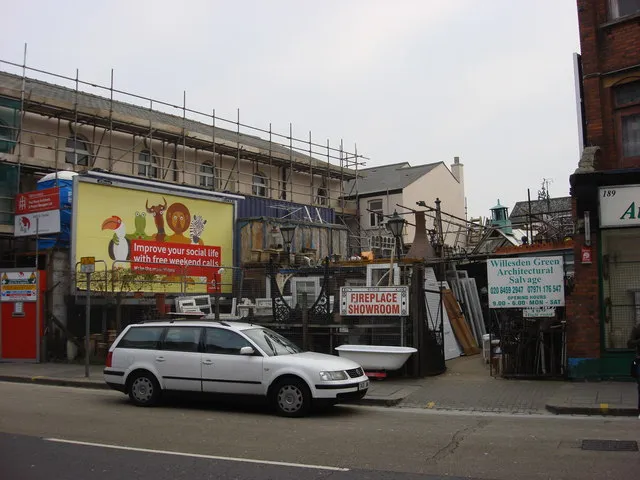
Photo: Oxyman, CC BY-SA 2.0, via Wikimedia Commons
There is a particular smell to an architectural salvage yard: wet stone, old varnish, creosote and the faint sweetness of dust. It is not a museum smell. It is a smell of interruption — of buildings that stopped being buildings and started being objects. At a yard on the edge of a Midlands town, a row of Victorian chimney pots stands like a choir that has forgotten the hymn. Nearby, a church angel lies on its side, nose chipped, wings intact. A pub mirror advertises a brewery that no longer exists. None of it belongs together. That is exactly the point.
Fragmenta is about piecing things together, and salvage yards are where Britain does that literally. They are showrooms for the dismembered: reclaimed bricks, cast-iron radiators, stained glass, pews, pub signs, garden urns, door knockers, railway sleepers, marble fireplaces. The trade is part demolition, part curation, part gambling. You buy a pallet of tiles because you might need them, or because someone else might. You sell a statue of a saint to a restaurant, a garden designer, a developer, a private collector who keeps it in a hallway. The fragment outlives its context. It becomes a sculpture by accident.
The yard as accidental gallery
Most salvage yards resist the white cube. They are muddy, stacked, labelled with marker pen. A font sits beside a bread oven; a row of theatre seats faces a wall of reclaimed pine. The eye makes connections anyway. A Victorian tile panel, cracked and grouted with moss, starts to look like an abstract painting. A length of church ironwork reads as a drawing in space. The yard is a gallery with no wall texts, no climate control, no promise that anything is art. That lack of officialness is liberating. You are allowed to like a thing without knowing what it is.
This is not a new British habit. The country has always been good at recycling its own past, sometimes for money, sometimes for sentiment. The Victorians salvaged medieval stone for garden follies. Post-war planners cleared terraces and sold off their fireplaces. The country house sale turned interiors into loose parts. In 2026, the trade is more visible than ever, partly because renovation culture has taught us to want original features, partly because demolition is a constant. Salvage yards are the quiet warehouses of that churn. They hold the bits that escaped the skip.
Why we keep the broken bits
A whole building asks for respect. A fragment asks for imagination. That is the bargain. A complete church is a monument; a chipped angel is a story. Who broke it? Where did it stand? Why was it saved? The object arrives with a gap, and the gap is the invitation. British culture has a long relationship with ruins — the picturesque, the romantic, the National Trust — but salvage is more ordinary than that. It is not about sublime decay. It is about the useful afterlife of things.
There is also a practical romance to it. Reclaimed materials carry carbon with them; reusing a brick is greener than making a new one. Salvagers talk about quality, about old timber that is denser than new, about lime mortar and real slate. But the environmental argument is only part of the appeal. People want texture. They want a floor that looks like it has heard conversations. In a new-build flat, a reclaimed door handle can feel like a small act of resistance.
The dealers and the detectors
The dealers are detectives of a sort. They read buildings before they come down. They know which auction to attend, which hotel is being stripped, which church has a faculty to sell a pew. They are not usually sentimental in public. They talk about stock, transport, storage, breakages. But listen for the exceptions. One dealer tells me he never sells certain things: a hand-painted sign from a shop his grandmother used, a set of tiles from a school. Another says the hardest part is not finding objects but letting them go. A yard is a waiting room. The dealer is a custodian who is also a seller.
Curators and designers use these places as research libraries. A theatre might borrow a row of seats for a set. A cafe might buy a bank counter. A museum might acquire a fragment because it fills a gap in a story. The trade sits between heritage and commerce, which makes it messy and honest. Nothing here is precious in the official sense. Everything is for sale, until it is not.
Memory, loss and the British compromise
Why do we cherish broken bits of buildings? Perhaps because Britain is good at managing loss by keeping the pieces. We do not always preserve whole things; we preserve tokens. A piece of the Berlin Wall in a garden centre, a lump of church stone in a rockery, a pub mirror in a kitchen. It is a compromise between memory and practicality. We cannot keep every building. We can keep a handle, a tile, a statue with a chipped nose.
That compromise can be criticised as nostalgia, or as heritage-lite. Sometimes it is. A reclaimed brick wall in a new development can be a way of buying atmosphere without history. But in the yards, the fragments are not yet décor. They are still evidence. The mud, the cracks, the inventory tags — these keep the object honest. The poetry of ruins is not that ruins are beautiful. It is that they are unresolved. A salvage yard is full of unresolved things. That is why it feels like a museum of the present, not the past.